An Integrated and Personalised Future for Healthcare
“Our driving force is helping people reclaim control over their health — and their freedom.”
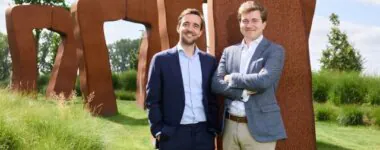
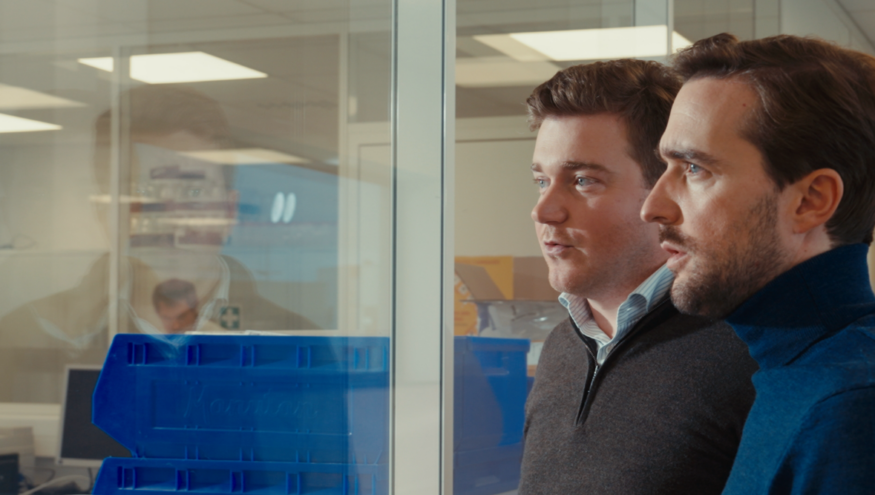
How founders Charles and Louis Declerck are building an integrated and personalised future for healthcare with erudite.health
What if healthcare were no longer reactive, fragmented, and transactional, but personalised and proactive — a continuous care journey that guides you from prevention, through timely intervention, to the daily maintenance of your health? For brothers Charles and Louis Declerck, this is not a theoretical question but a concrete mission. After extensive academic careers, they decided in 2022 to join forces. Not to build “yet another health company,” but to fundamentally rethink the healthcare landscape. With erudite.health, they want to reconnect patients, doctors, science, and technology into one unified system. Their ambition is clear: not to restore health once it is lost, but to protect, strengthen, and personally guide it every day.
The beginning of erudite.health
Louis: “It was early 2022 when Charles and I felt we really needed to do something together. But at that point there was no concrete idea yet. We were both working at a Biotechnology fund at the time — me in Leuven, him in Antwerp. In May 2022 I had had enough and we gave ourselves 6 months to focus and figure out how we would develop erudite.health. What would our health philosophy be? How would we balance acquisitions and technology? After that period, we founded erudite.health in December.”
Charles: “Louis and I very quickly got the feeling that there needed to be more than a purely transactional act in healthcare. You’re sick, you go to a doctor, you get a medicine, and you go back home.”
Complementarity
Charles: “I think it actually started much earlier than 2022. Louis and I have been two peas in a pod since childhood, despite the 6-year age difference. We always felt that we would work together one day, without consciously aligning our studies toward that. (Louis studied medicine and civil engineering; Charles studied bio-engineering.) As a result, we look at the same questions from different angles, which makes us enormously stronger.”
Louis: “Beyond our academic backgrounds and areas of interest, Charles and I are also very complementary as people. Not just because we’re brothers, but also in terms of personality. I know exactly what I want and I’m fairly straightforward. Charles is a bit more measured. That combination creates balance — within the organisation too.”
Charles: “There’s a connection between Louis and me that is hard to put into words. I often say that we share one brain, each with one half. We are so strongly attuned to each other that it not only helps us, but enormously advances the company as well.”
Louis: “That’s right. We don’t even need to speak to understand each other. We also get restless when we’ve been out of each other’s sight for too long. We realise how exceptional that is.”
Charles: “But what we want to do with erudite.health goes beyond us. It’s not about two individuals — it transcends our bond. It’s not about us as individuals, but about a greater purpose.”
A newborn child with a great mission
Louis: “Right now, erudite.health is a newborn child — young, full of potential, and with a great mission. A mission to fundamentally rethink healthcare. Not superficially or in a generalised way, but to its very core: how do we truly understand healing? We believe that healing comes first and foremost from the body itself. Medical professionals play an essential role in this: they read the body and can offer support through diagnostics and advice, but that remains primarily a symptom-focused approach. That is precisely where we want to intervene. By listening more carefully to the body — and, in a sense, whispering back to it — we can offer more targeted support. That can come through a wide spectrum of tools: healthy nutrition, sleep, movement, stress management, and if necessary, supplementation and medication. But there are no standard solutions. There is no one-size-fits-all for every problem. We want to make thoughtful and above all personal choices. An integrated and unified approach. Today we speak of this as unified medicine.”
Charles: “The problem with health is that it is often taken for granted. You only realise how valuable it is when it’s gone. At that very moment, recovery is often a great challenge and heavy interventions are needed, or we hit the limits of what is possible. How often do you hear from people around you: ‘I wish I had enjoyed it more while I could’ and ‘I wish I had taken better care of it.’ That is exactly where our core lies. Health is absolutely not a given — it is something you must cherish and maintain, just as you care for a young child. We see that awareness is growing, but it is still not sufficient, either among patients or among healthcare providers.”
“Health is absolutely not a given — it is something you must cherish and maintain, just as you care for a young child.”
Louis: “Charles raises something important, but erudite.health was not founded solely to keep healthy people healthy, as important as prevention is. We believe just as strongly that people who lose their health deserve more than being told that ‘this is simply their fate.’ Some may find that naïve and argue that certain conditions are irreversible. I genuinely believe we must always keep searching for recovery. Because life should be free and meaningful. Free in the sense that you should not be constantly limited by your body. Meaningful because you yourself should be able to choose how you fill your life. But to be able to choose that meaning, you must first experience that freedom. And that is precisely what drives us: helping people reclaim their health — and their freedom.”
“Helping people reclaim control over their health and their freedom — that is what drives us.”
A leap into the unknown
Charles: “Throughout the journey Louis and I have been on, we have had to let go of a certain kind of security above all else. We both jumped in with both feet. You think you have some idea of where you’ll end up, but in the end you’re working with people and things move fast.”
Louis: “Honestly? We’re built for this. If I had too much certainty, I’d deliberately turn it on its head. Not because I’m seeking chaos, but because I draw energy from the search and the discovery — from not knowing exactly where you’ll end up. That very tension motivates me. Personally, it doesn’t feel like I’ve had to let go of anything — I’ve only gained things. I’m enormously happy that we can do this together with a fantastic team. Where Charles and I used to do it alone, we now have a team of 130 people, and I’m incredibly glad about that.”
Charles: “It is very special to see how we, having started as two people, have been able to bring together a large and driven team in just over two years — a team that pulls together with full conviction.”
From fragmented to integrated care
Louis: “What frustrates us today is fragmented healthcare. A patient has to visit various health professionals to ultimately arrive at one overall picture of their care. Our goal is to unite that fragmentation. We want to do that not only through products, but above all by offering a service. That service is coming this year and is designed to connect patient and healthcare provider — and it is the layer where we believe we will make the difference.”
“The service is the layer where we believe we will make the difference.”
Charles: “The classic cascade system within healthcare — where patients are referred from one doctor or specialist to the next — often leads to information becoming fragmented and not flowing optimally. That rarely benefits the patient. At the same time, we see a clear evolution: patients increasingly want to take control of their own health. An awareness is growing that a purely symptomatic approach is no longer enough. Taking a painkiller for a headache without looking further at the underlying cause is no longer the right path for many people. People today are looking for a more thoughtful, integrated, and sustainable approach to their health.”
Louis: “The patient searches the internet and receives advice from all sorts of parties claiming their product is the best. But the problem with that search is that it is unguided. What is actually best? What is science? That is what we want erudite.health to provide a solution for this year. Through the service, we finally want to be a companion for both the doctor and the patient, and to strengthen the connection between both parties. Let me be very clear: it is absolutely not our intention to replace the doctor through our tools and services, or to perform diagnostics ourselves. All we want to achieve is to better connect the patient with the healthcare provider, so they can reach a sustainable and scientifically grounded solution more quickly.”
Charles: “Our ultimate goal is to build fully personalised care pathways, so that patients gain more control over their health. For doctors, we want to offer a practical and reliable tool — a valuable addition to their toolbox — that helps them guide patients toward sustainable recovery more quickly and in a more targeted way.”
“It is absolutely not our intention to replace doctors or to make diagnoses ourselves. We want to form the bridge between patient and healthcare provider, so that people reach a sustainable and scientifically grounded solution more quickly.”
Copy, transform, combine
Louis: “Within erudite.health, we strive for a beautiful balance between innovation, technology, and science. Science starts with fundamental questions — for example, what is the link between the gut and the brain? How do biological processes influence each other? Step by step, we search for insights. Then there is technology, with the goal of translating that knowledge into a tool to change something and create impact on processes. That can happen through biotechnology, but also through a device or method. Technology makes science applicable. In my view, innovation is copy, transform, combine. You copy something from the past, transform it, and ultimately combine it. A completely new wheel is rarely invented. I also don’t think we should aspire to that. What we do want is to deploy existing insights and technologies in a new way — sometimes even by drawing inspiration from other sectors such as space, automotive, and engineering, and translating those principles into healthcare.”
“In my view, innovation is copy, transform, combine. A completely new wheel is rarely invented.”
rinciple. Everyone wants to come out with something new and create a lot of fuss around it, but we believe in the principle of ‘never change a winning formula.’ We should primarily keep building on the things that work. The better you understand the science and the problems surrounding it, the better the innovation will be. In our view, innovation must flow from real problems — not because you want to develop the next big thing.”
Louis: “Exactly. We truly start from the patient’s medical need. What gaps exist, and how can we respond to them?”
Charles: “Innovation doesn’t always have to be extremely sexy. Yes, we are here to change the world, but that will still take some time. Real innovation often lies in solving problems that have no answer yet. We both come from the biotech world, where we worked on serious pathologies for which no treatment pathways are available yet. Those are the domains where patients are often told: ‘If you had gotten this disease 10 or 20 years later, there might already be a solution.’ We saw that very clearly during our training as well. There is always a point where science stops today. It is precisely that gap — where science currently stops — where the search for new solutions begins, and that is also the part we find most exciting.”
Louis: “We also don’t want to focus solely on the most serious pathologies — we want to solve the more accessible problems too. Chronic conditions also have a significant impact on the daily comfort of many patients. Think of irritable bowel syndrome. Those patients also often go through years of suffering before they get real help.”
“Innovation doesn't always have to be extremely sexy. Real innovation often lies in solving problems that have no answer yet.”
Deliberate choices
Louis: “In writing the erudite.health story, we have very consciously chosen not to make certain choices. We knew very quickly that we did not want to develop our own brand of medicines or supplements. We therefore started from acquisitions, because that way we immediately had credibility, science, and market share. Those three things had to be perfectly aligned — and that has been enormously difficult.
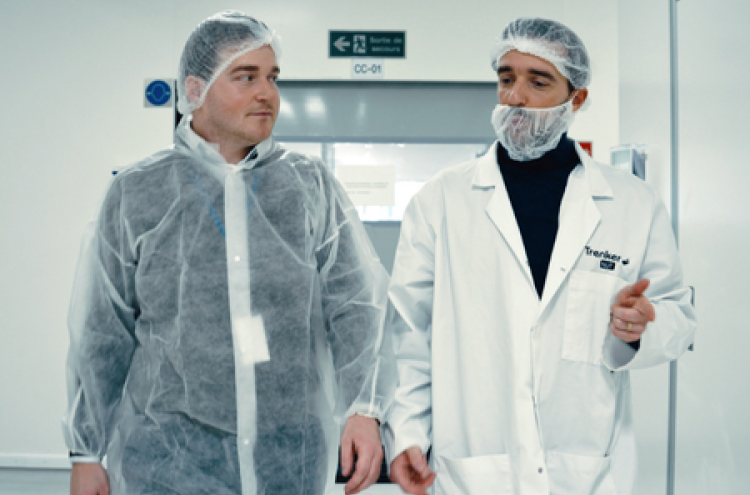
We looked very critically at our own country to see whether there were interesting companies. In the end, we chose Nutriphyt and Labo Trenker. Nutriphyt for its history and the scientific basis of its formulas. The vision of the late Gabriël Devriendt also stood out for us. Trenker was the next logical choice because they have production in-house — and not just any production, but the best. Now it is up to us to prove ourselves to our community of patients, healthcare providers, and partners.”
2026 as a new turning point
Louis: “2026 is an important year for erudite.health — a new turning point. First and foremost, we are building care in the form of targeted services, which we are translating into clear specialisations. That means we don’t work in a general way, but per health domain. Take someone with gut complaints, for example. We don’t just want to approach that person symptomatically, but support them through an integrated and personalised care pathway. Concretely, we start from three fundamental pillars: nutrition, movement, and stress management. For each category, we are developing targeted guidance in the areas of medical nutritional advice, mobility, and lifestyle, supplemented by support where needed. That way, we are building step by step toward practical, applicable pathways that help people sustainably improve their health.”
Louis: “But medical nutrition is far more complex than people think. It’s not so much about healthy eating, but about nutrition that is scientifically substantiated. About understanding the relationship between specific ingredients and what happens in the body. There is a great deal of strong science around this today, supported by excellent researchers both nationally and internationally. We deliberately choose an agnostic approach: no dietary labels, but science as the starting point. If research shows, for example, that nightshades like tomatoes are better avoided during an inflammatory phase, we translate that into concrete advice. Not ideological, but evidence-based. Today, a patient is often presented with a product or medication — which can be valuable in itself — but that alone is not sufficient in our view. That remains transactional. We believe guidance needs to go broader. What does someone eat? How do they live? How do you support sustainable recovery? Later this year, an AI tool is coming that we want to integrate into this service. I can’t say much about it yet, but it won’t be just another nutrition app.”
“Our ambition is clear: everyone, everywhere, must have access to quality support for their health.”
International ambitions
Charles: “We see the erudite.health story as a big one. Internationalisation is a clear priority — within Europe, but also beyond. Our software and services must become an inherent part of the healthcare landscape in every country. At the same time, we realise that this is no simple task. Every country has its own validated channels, regulations, and care pathways. That requires a well-considered approach.”
Charles: “For us, software acts as a flywheel: a lever that accelerates our ambitions and enables scalability. In addition, we also want to make our products — developed and produced in Belgium to the highest quality standards — more widely available through strong distribution partners. Our ambition is clear: everyone, everywhere, must have access to quality support for their health.”
From vision to impact
Louis: “If we look back at the end of this year, I hope above all that we will have built real traction. I want all healthcare professionals to be convinced of the principle that alongside a classic and transactional circuit, there is also room for unified medicine. I want us to be able to show concrete results. Strong cases. Real impact on the lives of patients. That we have not only treated people, but given them back their freedom.”
Looking to the future
Charles: “If we look further than this year and ahead to the next ten years, then this builds on what we’re doing now — but on a larger and broader scale. Within ten years, it should even be about philosophy. That we will have been able to shift something in the mindset of every healthcare professional and in the perception of how they look at health and recovery. If we can shift that perception, then we will have truly changed something fundamental.”